ATLAS Star Tracker
A low-cost equatorial star-tracking mount designed to be built by hobbyists.
Class Project
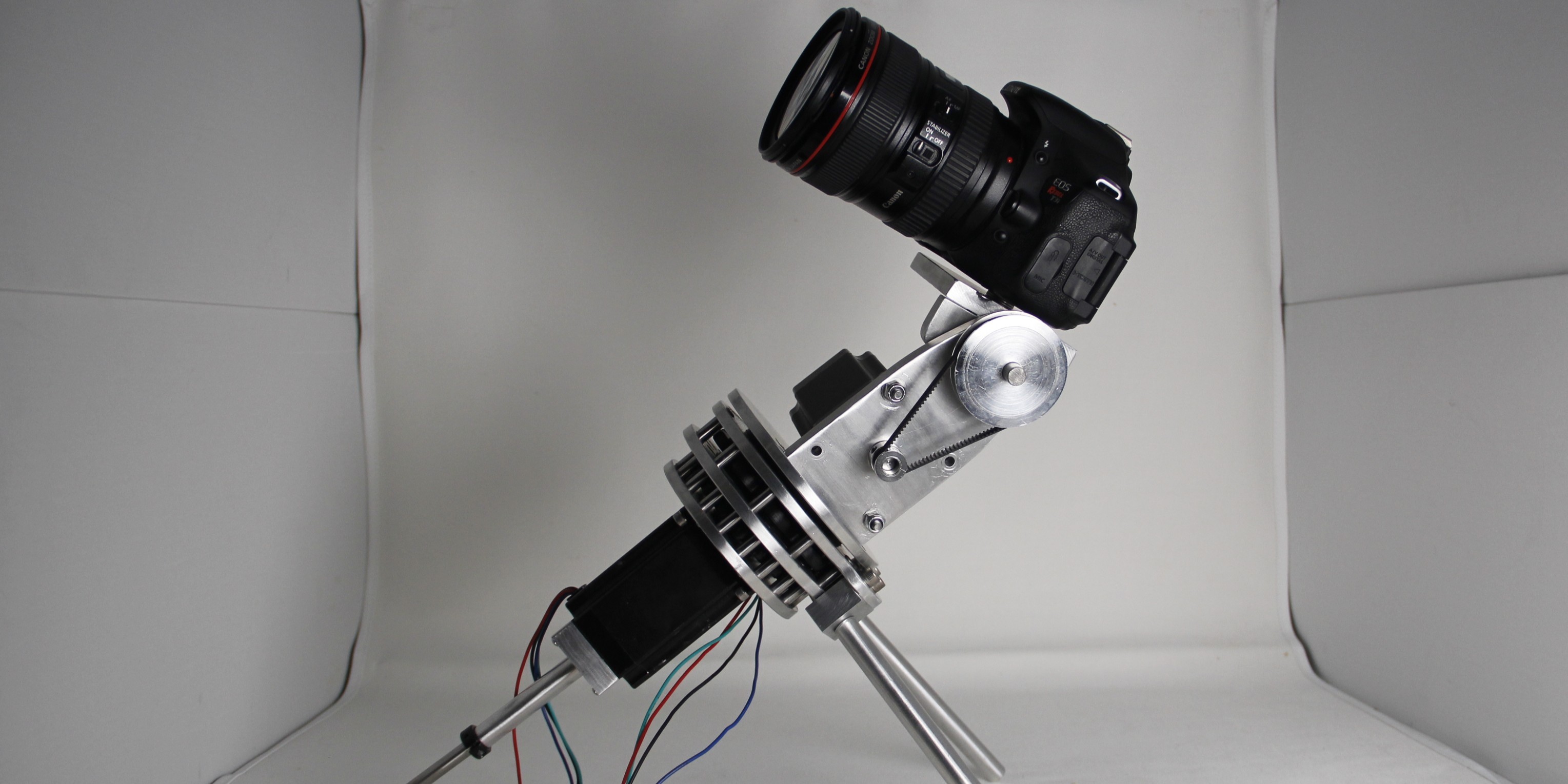
Overview
ATLAS aims to decrease barriers to long-exposure astrophotography by providing a low-cost star tracking system for under $250. Designed to compensate for Earth’s rotation, the system features a versatile mount designed for cameras, but adaptable to telescopes. Designed to be manufacturable completely on a 3D Printer, but optionally on a hobbyist CNC router, or even a manual mill.
ATLAS was designed by a 5-person team over an 8-week scrum-style workflow where we exercised iterative and agile design practices.
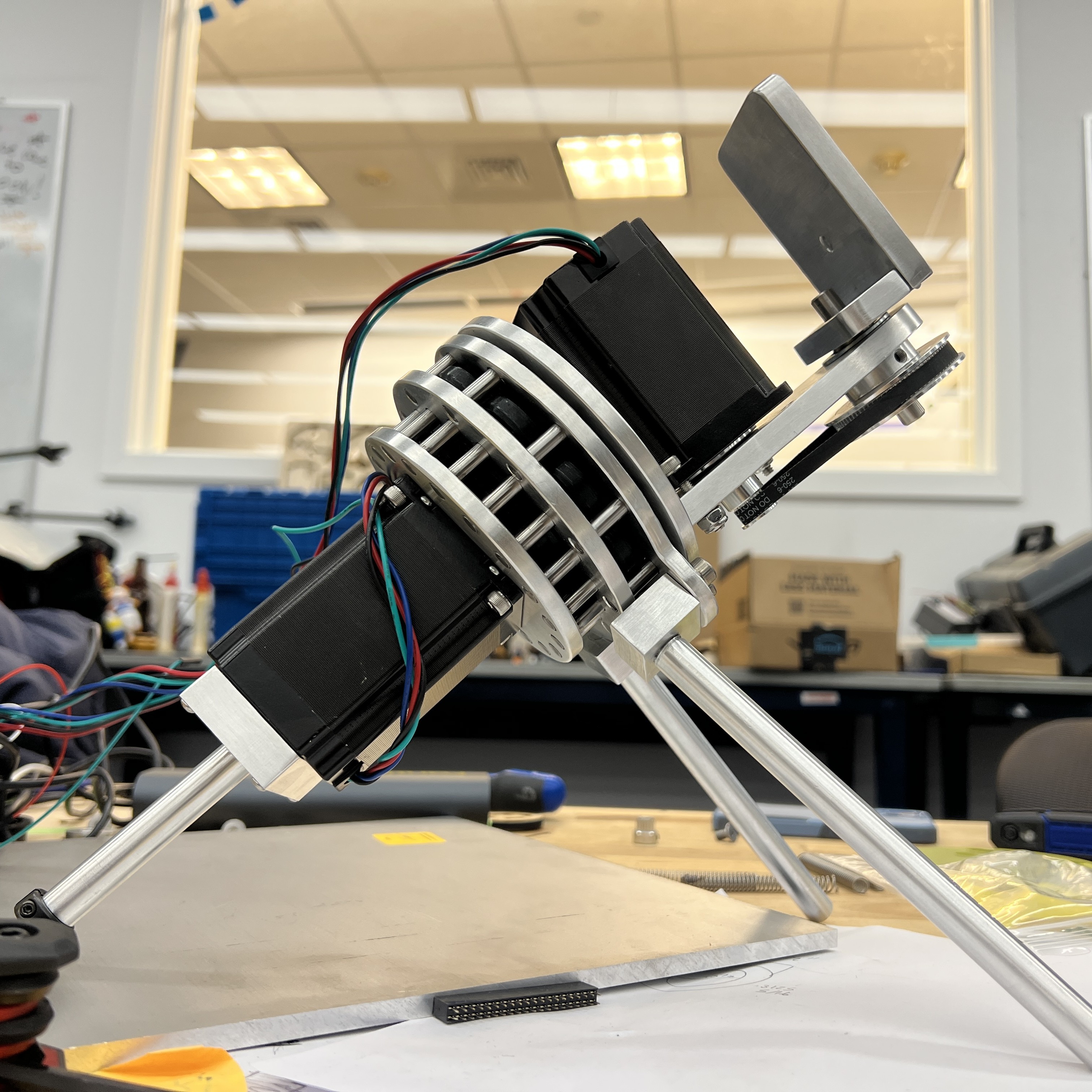
In order to smoothly track the stars, it’s crucial to be able to make miniscule movements at an extremely slow rate. To accomplish this, I lead the creation of a Cycloidal Drive: An unconventional type of ‘gearbox’ that can provide high gear reductions inline with a shaft, at extremely high precision and with very small amounts of backlash if designed properly.
Mechanical Design
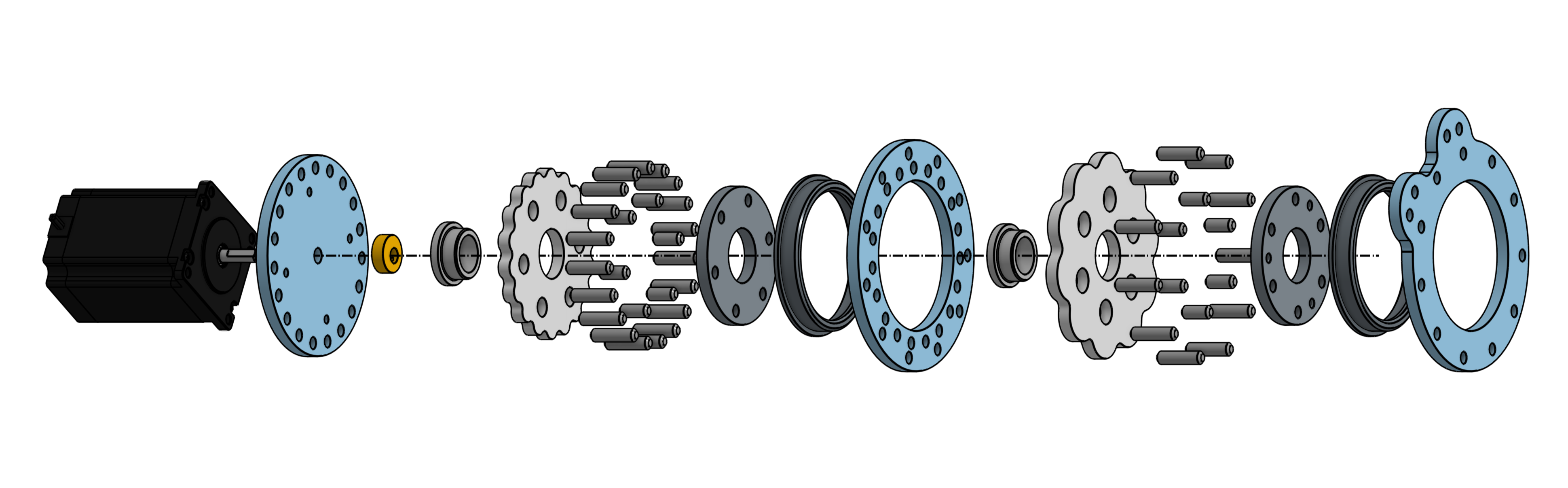
The drive works by turning a flower-shaped ‘gear’ eccentrically, causing it to walk around, meshing with an outer circle of pins, and turning an internal ring of pins. There is conventionally one more pin than there are lobes, which creates a gear ratio of 1:[# lobes].
For our purposes, I took into account a number of factors. First, the earth rotates at a rate of 0.025 degrees per minute. It's necessary to follow this rotation very closely, to ensure that the star you're interested in stays perfectly centered for long exposure photography. These factors ultimately led me to choose a 180:1 gear reduction, which gives us a rotation rate of 0.01 degrees per step on the stepper motor. We chose to accomplish this ratio through a two-stage reduction. By using a 10:1 drive, inline with an 18:1, we could achieve extremely accurate results without too much additional mechanical complexity.
Prototyping & Fabrication
Prototyping was initially done on Prusa MK3 FDM printers to create a final product that would be manufacturable by a decently-equipped hobbyist. A complete two-stage drive could be completed in a matter of hours, and produced a shockingly robust system.
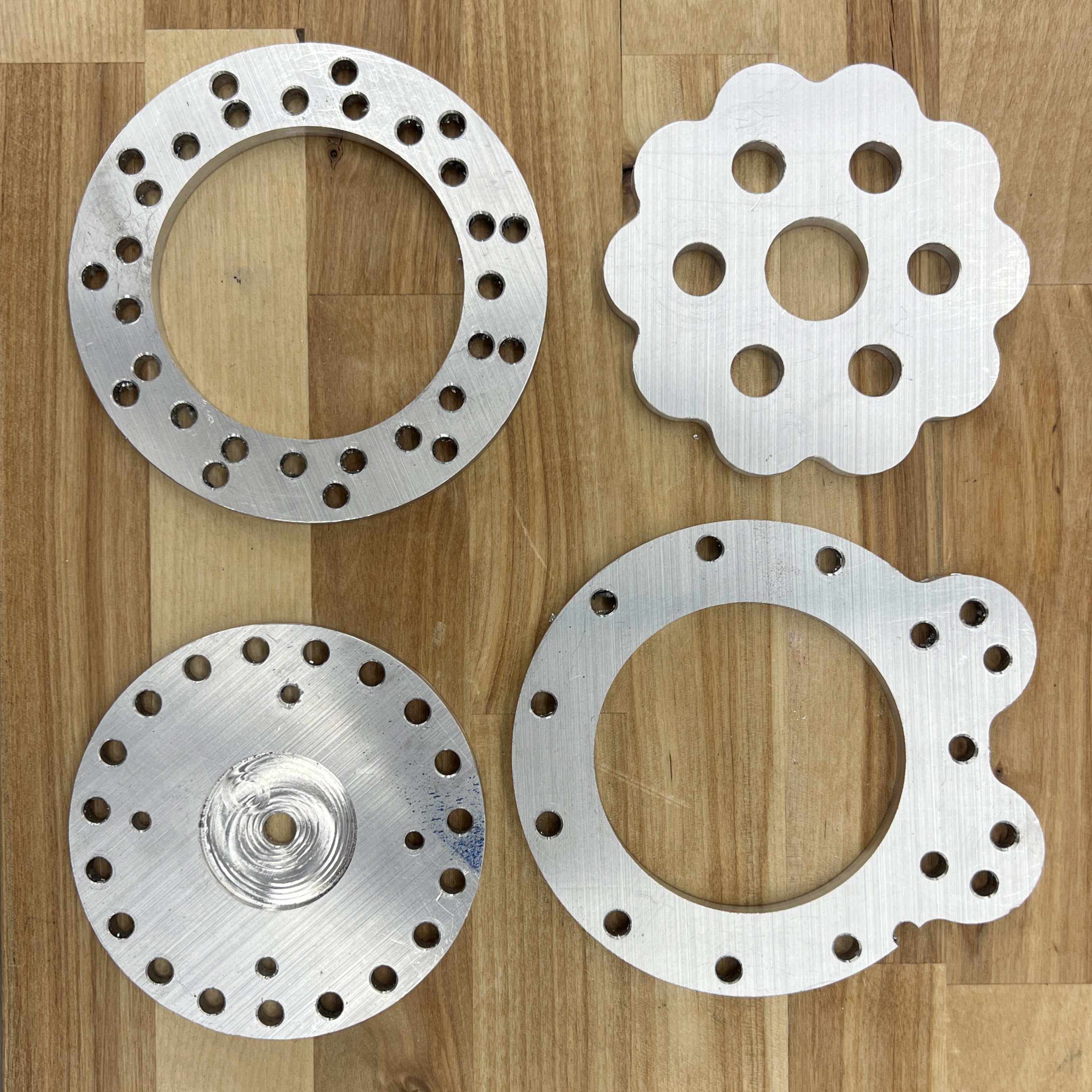
I also manufactured a 1/4" 6061 Aluminum assembly to validate this aspect of my DFM. The plates were milled on a fixture plate using a MILLPWR G2 2.5 Axis CNC system, and are (carefully) press-fit together using COTS 1/4" dowel pins and bushings.
Results & Reflection
In the end, the mount, and particularly the Cycloidal Drive, performed exceptionally. We were successful in capturing photos of Jupiter and Sirius (click below), tracking the stars over 30s and getting clean results without streaking. A website with greater detail on the project can be found here.
If I could change one design choice, I would revise the assembly process for the plates. Currently, it involves carefully performing ~50 FN2 press-fits. This isn't an issue with the 3D Printed version, however, for the aluminum version it requires a large press. Disassembly becomes a much more difficult process because of this as well. I chose press-fits for the aesthetic opportunity, and knew it would be hard, but I didn't realize how hard. If I had to do it again, I'd sandwich the pins between the plates using a few standoffs to apply pressure
